News & Media

Market Perspective – Third Quarter, 2026

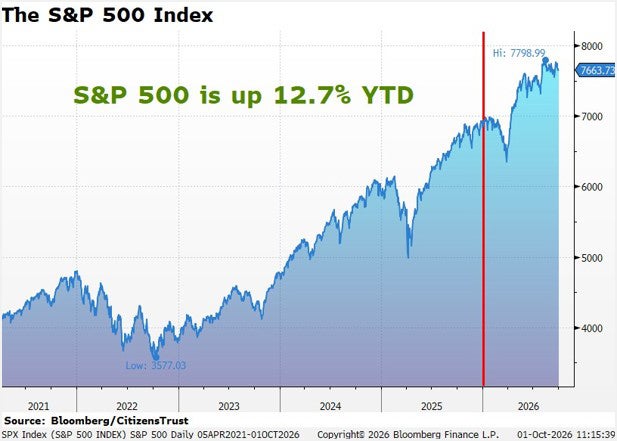
The third quarter exhibited an equity market that climbed and a bond market that did not. However, equity returns were dominated by the large, AI-related stocks while the broader equity market and bonds digested a more hawkish Fed and a rising interest rate environment.
Equity Markets
The S&P 500 rose 2.0% in the third quarter and is now up 12.7% YTD. Large-cap U.S. equities finished higher, but the leadership was narrow and the path was volatile. The capitalization-weighted S&P 500 continues to be heavily influenced by the largest technology-related companies. Just in the month of September, the technology and communication services sectors were both up over 4.3%, while every other sector in the index was down. These two sectors now make up more than 51% of the S&P 500 index and that record-setting weight is expected to grow. SpaceX became publicly traded during the quarter with a two-trillion-dollar market cap, and it will be added to the index in the middle of next year. The upcoming public debuts of Anthropic and OpenAI will also add to technology’s influence on equity markets.
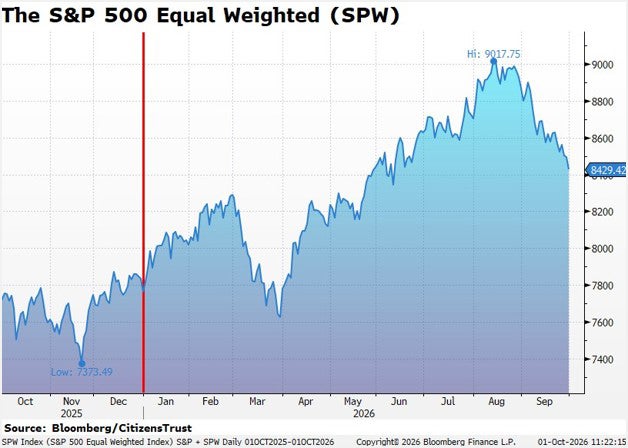
The rest of the U.S. equity market struggled with a Federal Reserve that began raising rates again, a ten-year Treasury yield back above five percent, and elevated energy prices tied to the war in Iran. Investors refer to this dynamic as bad market breadth and it is exemplified by the performance of the “equal weighted” S&P 500. This broader measure of market performance has declined roughly 6.5% since Fed Chairman Kevin Warsh gave a hawkish speech at the Fed’s annual conference in Jackson Hole. By comparison, the S&P 500 index was less than two percent away from its recent high reached in late September.
As noted, smaller companies had a rougher third quarter. Mid-cap stocks, as measured by the Russell Mid-Cap ETF, fell 3.0% and are now up 11.8% YTD. Small-cap stocks, as measured by the Russell 2000 Small-Cap ETF, dropped 7.3% in the quarter and are now up 13.7% YTD. The weakness in smaller market cap equities was a reversal from the previous quarter and is not unusual when longer-term interest rates move sharply higher.
International equities were mixed during the third quarter as emerging markets pulled back and developed markets were stable. Several of the largest emerging market equities are within the semiconductor supply chain and they consolidated after dominating upside performance in the previous quarter. Emerging markets, as measured by the EEM ETF, fell 2.4% in the quarter leaving the YTD gain at 22.7%. International Developed markets, as measured by the EFA ETF, were unchanged during the quarter and are up 9.9% YTD. Globally, the MSCI World Index rose 1.1% during the quarter and is up 12.9% YTD.
Interest Rates
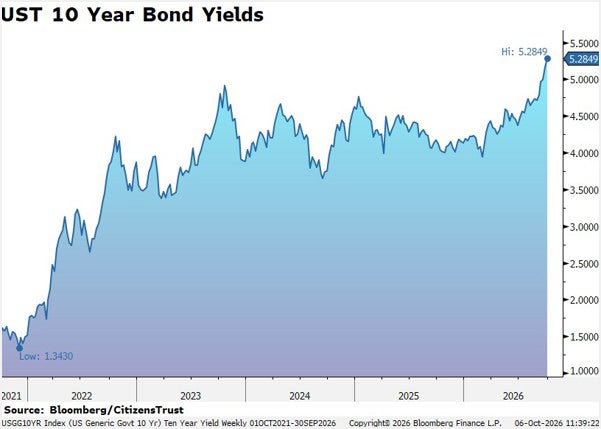
The bond market is where all the action was in the third quarter. The ten-year Treasury yield ended the quarter at 5.28%, the highest yield since 2007. The gain in yield of over 80 basis points put significant pressure on bond prices across the fixed income market. The Bloomberg Aggregate Index, a broad measure of the U.S. bond market, declined 3.5% in the third quarter, leaving the YTD drop at -2.9%.
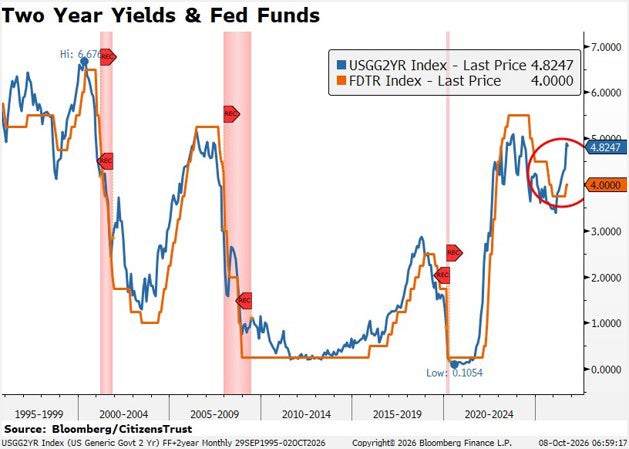
President Trump was not averse to putting public pressure on the Fed to lower interest rates, especially under former Fed Chair Jerome Powell. Market pundits were thus led to believe that the chairman he appointed, who took over in June, would be more open to interest rate cuts and a more accommodative monetary policy. Well, Chairman Warsh held only his third Fed meeting in September, and he didn’t cut rates, he raised them. The Federal Open Market Committee vote was unanimous at 12-0. It was the first hike in the fed funds rate since July of 2023. Kevin Warsh was looking to establish some credibility with the bond market as an inflation hawk. He started with his speech in Jackson Hole and followed through with a rate hike. In addition, the Fed’s “Summary of Economic Projections” suggested further rate increases in the future. The bond market appears to be listening as the two-year Treasury yield remains well above the fed funds rate.
A higher interest rate environment will pressure rate-sensitive industries, such as housing, where home builders are facing high mortgage rates. Higher interest rates can reflect a strong economy, a Fed that is fighting inflation, high U.S. debt levels, or a combination of many such factors. Regardless, yields are at relatively attractive levels in comparison to the last 20 years and a higher rate regime is expected to persist into next year. The Fed is serious about fighting inflation and bond buyers are demanding higher yields across the curve.
The Ecomony
The U.S. economy continues to expand and appears to be getting stronger as the year progresses. The most recent estimate of second quarter GDP growth was revised up to an annualized rate of 2.2%. Resilient consumer spending was the primary driver behind the upward revision. A cleaner read on underlying domestic demand is “final sales to private domestic purchasers”, and it has been trending higher than GDP growth as declining government spending and increasing imports have been a drag on GDP. The Fed’s September statement described activity as expanding at a solid pace and productivity growth as strong. The ISM Composite confirms that strength with the third quarter measures well into expansion and the best 3-month average in four years.
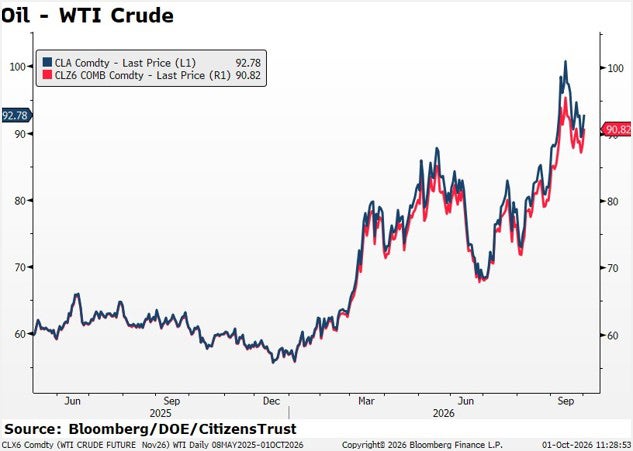
The primary economic concern in 2026 remains inflation. While inflation measures were cooling before the Iran conflict began, higher energy prices since February have spiked inflation. Excluding energy, consumer prices are up 2.5% from a year ago, which is the smallest increase since the pandemic. Thus, much of the increase in headline inflation measures are due to energy. Unfortunately, the decline in oil prices during the summer was short-lived and WTI crude oil is back near $90 per barrel.
The conflict in Iran has been the exogenous economic shock of the year but the offset to the economy has been the capital spending cycle in artificial intelligence. The already hard-to-believe capex budgets continue to rise globally and most estimates for next year are above $1 trillion. The AI supply chain can support a respectable level of GDP growth while the economy feels tight to households as energy prices and financing costs are elevated.
The Quarter Ahead
Oil prices will be the macroeconomic swing factor in the fourth quarter. If crude oil flows out of the Middle-East do not recover and energy prices continue to rise, it will weigh on economic forecasts for next year. The mid-term elections will be over in less than a month and President Trump has hinted at some kind of resolution after the election. The energy market is not buying it, and contracted oil prices for 2027 are near their highest levels of the year. The market expects one more rate hike at the Fed’s December meeting, which is likely given that inflation measures are unlikely to improve in the short term.
Corporate profitability will continue to do the heavy lifting for equity markets and the economy. S&P 500 earnings expectations continue to grow at an impressive rate. If third quarter results are near expectations, it will be the third consecutive quarter of earnings growth above 25%. This remarkable rate of earnings growth is being driven by the energy, technology, and communications services sectors. Yes, a handful of tech companies have an outsized impact on growth rates but that is a good thing. All eleven sectors of the S&P 500 are expected to grow earnings this quarter. The S&P 500’s forward P/E multiple has declined over the past year and currently sits below its five-year average.
We look forward to serving you and appreciate the trust you have placed in us. Please reach out to your CitizensTrust representative with any questions you may have.
Learn more about CitizensTrust.
Content provided by: R. Daniel Banis, Executive Vice President, Head of CitizensTrust, and Donald Evenson, Senior Vice President, Chief Investment Officer.
CitizensTrust is a division of Citizens Business Bank, N.A.
Trust and Wealth Management are provided by CitizensTrust Wealth Management. The information provided is an opinion on economic outlook and not investment advice. The information is not offered with a product or service. This information is not intended to be a substitute for specific tax, legal, or investment planning advice. We suggest that you discuss your specific questions with your qualified tax, legal or investment advisor.
| Not Insured By FDIC or Any Other Government Agency ● Not Bank Guaranteed ● Not Bank Deposits Or Obligations ● May Lose Value |